 May 2008. This is a photo of photos used in filming “Catervention.” The image is prescient insofar as it foreshadows the whole Cats and Catts experience. On the right, you can see my very first orchid, a mottled purple Phalaenopsis. It had already begun its death spiral and you can see the ugly leaf damage. It was a kind gift from a friend, but I had no idea how to take care of it and the air roots freaked me out. I can’t remember if I overwatered it or underwatered it, but it went to an early grave. I waited over a year before trying my luck again.
 Tuesday, January 26, 2010
My First Orchid
May 2008. This is a photo of photos used in filming “Catervention.” The image is prescient insofar as it foreshadows the whole Cats and Catts experience. On the right, you can see my very first orchid, a mottled purple Phalaenopsis. It had already begun its death spiral and you can see the ugly leaf damage. It was a kind gift from a friend, but I had no idea how to take care of it and the air roots freaked me out. I can’t remember if I overwatered it or underwatered it, but it went to an early grave. I waited over a year before trying my luck again. 

Sunday, January 24, 2010
Bean and the Big Catt

Friday, January 22, 2010
Fish Friday!
 Abe fAbe is the resident fish. Named after Abe Vigoda, Abe has a prime place in the kitty's house. He receives an enthusiastic greeting from Trixie every morning ("jazz hands!"). One could argue that he's one of the most spoiled betas in town. Even the kitties show him respect.
About a month ago, he had a case of tail rot that we quickly spotted and treated. We used water that we had left out for a day or so, thinking that airing it out would allow the chlorine to dissipate. A friendly worker at Pet World explained that water in our region is infused with chloramine, which can't be aired out. Abe hasn't had any trouble since we switched to reverse-osmosis water.
Jazz hands!
Monday, January 18, 2010
Dancing to the Drumbeat

Riley was acting like an especially freaky freak, so Trixie took a few photos of him moving around the Lc. Drumbeat 'Heritage' I purchased from Oak Hills Gardens. Trixie took this photo only a few days after I repotted the plant in a 6" clear pot. The medium in its prior pot had broken down and started to resemble mush. It loves the new arrangement and has thrown down dozens of new roots in its new container. Maybe Riley anticipated the plant's excitement?
 Or maybe Riley was celebrating its lustrous pedigree? Lc. Drumbeat was officially registered in 1969, and Fred Stewart's 'Drumbeat' received HCC recognition (77 points) at the Mid-America Regional Judging in St. Louis in 1970. Stewart's lesser-known Lc. Drumbeat 'Triumph' also received HCC status with 75 points the same year. I don't know much about Fred Stewart except that a 1966 (Apr. 17) Los Angeles Times article noted that he was one of the leaders in creating miniature cybidiums. Most recently, a 'Heritage' plant owned by Eden Hill Greenhouses and Timothy M. Volas received 90 points and a Certificate of Cultural Excellence (CCE) award from the AOS at the 2004 Greater Lansing Orchid Society Show. It's worth owning AQ+ simply so you can see a picture of this beauty -- thirty-four flowers, 27 buds, and you can almost smell the perfume from the computer screen.
Lc. Drumbeat is bred from no fewer than nine Cattleya species (C. dowiana, C. mossiae, C. warscewiczii, C. trianaei, C. gaskelliana, C. luddemanniana, C. labiata, C. mendelii, C. warneri) over a period of six breeding generations. Of these species, C. dowiana stands out as perhaps the most important, giving yellow and red veining to the lip. The yellow petals and sepals of dowiana are extremely recessive, so the lavender in Drumbeat is amply covered by L. purpurata (its sole Laelia influence), C. trianaei, and C. labiata.
Riley made a handy chart so you can keep it all straight:
Relationship to Lc. Drumbeat | Plants in Lc. Drumbeat | Parentage |
Lc. Drumbeat | Lc. Bonanza x C. Horace | |
Parent | Lc. Bonanza | Lc. Cavalese x C. Prospector |
Parent | C. Horace | C. trianaei x C. Woltersiana |
Grandparent | Lc. Cavalese | Lc. Lustre x C. Fabia |
Grandparent | C. Prospector | C. Remy Chollet x C. |
Grandparent | C. Woltersiana | C. Queen Mary x C. Rajah |
Great-Grandparent | Lc. Lustre | Lc. Callistoglossa x C. luddemanniana |
Great-Grandparent | C. Fabia | C. dowiana x C. labiata |
Great-Grandparent | C. Remy Chollet | C. Monarch x C. trianaei |
Great-Grandparent | C. | C. Lord Rothschild x C. mendelii |
Great-Grandparent | C. Queen Mary | C. mendelii x C. warneri |
Great-Grandparent | C. Rajah | C. Empress Frederick x C. |
Great-Great-Grandparent | Lc. Callistoglossa | C. warscewiczii x L. purpurata |
Great-Great-Grandparent | C. Monarch | C. Empress Frederick x C. trianaei |
Great-Great-Grandparent | C. Lord Rothschild | C. dowiana x C. gaskelliana |
Great-Great- Grandparent | C. Empress Frederick | C. dowiana x C. mossiae |
Great-Great- Grandparent | C. Enid | C. mossiae x C. warscewiczii |
Saturday, January 16, 2010
False Phalaenopsis Accusations

I blamed Griffin, in part, because Phals were supposedly one of the easiest orchids to grow. If my other orchids were thriving, how could this basic orchid, sold to masses, suffer blasted blooms? It must be Griffin.
Then, I saw signs of crown rot and I discovered that the roots were packed in sphagnum moss. There was no other growing medium except sad soggy moss that was undoubtedly drowning the plant and cutting its oxygen. I do not doubt that one can grow phals successfully in sphagnum, but it definitely wasn't working for me or the kitties. What to do?
I read this helpful entry in allexperts.com from an orchid owner (Vivian) struggling with a similar situation. The resident expert (Wayne) encouraged Vivian by noting, "You were right to get the plant out of the sphagnum and into a fir-based orchid potting mix." I wanted to do the right thing, too, so I bought special phal. bark at Sunrise Gardens and repotted it. A week later, it still looked miserable. Thinking back to it, I probably didn't let it dry out enough for it to stage a full recovery.
After the final leaf dropped, I cursed the Phalaenopsis genus, threw the plant in the backyard to decompose, and gave Griffin a sincere apology.
Tuesday, January 12, 2010
How Cute is Too Cute?
 Bumped in the head at four in the morning. Waking up to Riley licking your ear an hour later. Unable to type at the computer without him jumping onto your lap. Following you into the bathroom, into the kitchen, and everywhere else. Giving pose after adorable pose. Trying to steal the show at every turn. These are conditions that lead one to ask "How cute is too cute?" There are websites devoted to this issue, but Riley forces us to live with it on a daily basis.
Here he is on a late summer day, posing between the blooms of two oncidium hybrids: Colmonara Wildcat 'Green Valley' and C.M. Fitch Izumi. Too cute? It's possible.
Sunday, January 10, 2010
The Joys of Grocery Shopping

Orchids from grocery stores can be an inexpensive way to expand a collection, and you can also feel good about saving an orchid from a probable death. The downside is that many of these plants are NOIDs or under-labeled. So, I was happy to see that Bean's favorite white Dendrobium was labeled as Den. Woo Leng x Den. Burana White. Woo Leng is a cross between Den. Loan Sudharta x Den. Yong Kok Wah registered in July 1989. I found only a smattering of information about Burana White. It doesn't make the flowers look any prettier, but Bean appreciates that this one wasn't labeled "White Dendrobium" as it so easily could have been.

Friday, January 8, 2010
Frog Friday!

Alice crawls past the Certostylis, away from the Onc. velutinum. This photo was taken during September shortly after my purchase, back when it was looking hale. Now, the Oncidium is on my RIP list after a tough few months. It was difficult to figure out what it liked. It needed consistent watering because it's mounted, but it was in a high humidity environment so maybe it didn't need as much watering as I thought. Complicating matters, crickets ate chunks from the main leaves, hasting its death. We experienced a short period where we had too many large crickets in with the frogs and they went after that plant in particular.
In any case, I certainly couldn't trust Alice to watch over it. She's only interested in crickets and the scenic view.
Wednesday, January 6, 2010
The Importance of Labels
I have a few plants in my outdoor garden that I can't completely identify because I lost the garden markers. Is that peach-colored daylily 'Morning Sunrise?' 'Peach Surprise?' 'Peachy Delight?'
Embarking on the orchid journey, I vowed not to repeat my mistakes. Frowine's Orchids for Dummies devotes three pages (37-39) to the advantages and disadvantages of various label markers. I'm following his advice to have a separate list of my collection. I'm using that document to create typed labels that I'm taping to pots. A few have smudged with watering, but it's been easy enough to replace the labels.
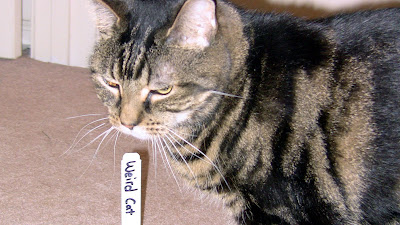
This got me thinking -- maybe I should I should label the kitties so I don't lose track of them. Here's what I came up with:



Embarking on the orchid journey, I vowed not to repeat my mistakes. Frowine's Orchids for Dummies devotes three pages (37-39) to the advantages and disadvantages of various label markers. I'm following his advice to have a separate list of my collection. I'm using that document to create typed labels that I'm taping to pots. A few have smudged with watering, but it's been easy enough to replace the labels.
This got me thinking -- maybe I should I should label the kitties so I don't lose track of them. Here's what I came up with:


Monday, January 4, 2010
Who is C.M. Fitch?

The orchid that commands the center spot on the table is my Miltassia C.M. Fitch ‘Izumi’ AM/AOS. It’s a cross between a Miltonia spectabilis and a Brassia verrucosa. The Miltonia gives it the purple and the Brassia gives it the long narrow tepals. I wonder, who is C.M. Fitch? When did he create this hybrid? When did it win an AOS award? What’s Fitch’s story?
Charles Marden Fitch is the author of several books about plants and orchids. He is a recipient of the Gold Medal of Achievement award from the AOS. Fitch's CM Fitch 'Izumi' received 80 points at the Annual Hilo Orchid Society Show in July 1997. He’s been an orchid judge since the 1970’s and he’s renowned for his orchid photography. Fitch has been speaking publically about the joy of orchids since at least the early 1960’s. C.M. Fitch is impressive because his botanical knowledge extends far beyond orchids. He tackled lilies, azaleas, bamboo, and aloe in articles he wrote for Flower Grower, Horticulture, and Flower and Garden during the 60’s and 70’s. In 1977, he published a book about terrariums and, a few years later, a book about miniature roses.
The earliest article I found was a piece on the spider orchid in the January 1961 issue of Flower Grower. The earliest public speaking reference I found was an announcement for a talk titled “Orchid Culture at Talisman Cove” he gave to the Greater New York Orchid Society (NYT, Aug. 19, 1962, pg. 112). (I expected to find a Talisman Cove in New York but, instead, I think it refers to his orchid shop or lab.) In the latter part of the 1960’s, Fitch regularly gave talks and classes about orchid culture. The most recent reference I found took me to Fitch’s report from the 2009 Taiwan International Orchid Show. He’s had a long and productive career, combining a love of photography and plants, and he’s still going strong.
Fitch talked specifically about Cattleyas in an article he wrote for the New York Times in 1984. He said that compact plants in the Cattleya alliance maximize the color a grower can achieve with minimal space. In particular, he recommended Hazel Boyd, Madge Fordyce ‘Red Orb,’ and Jewel Box Sheherazade. (“An Orchid Expert Makes it Sound Easy,” Nov., 25, 1984, H31.)
But I have many more questions, not the least of which is: was Charles M. Fitch a cat person or a dog person?
Subscribe to:
Posts (Atom)


