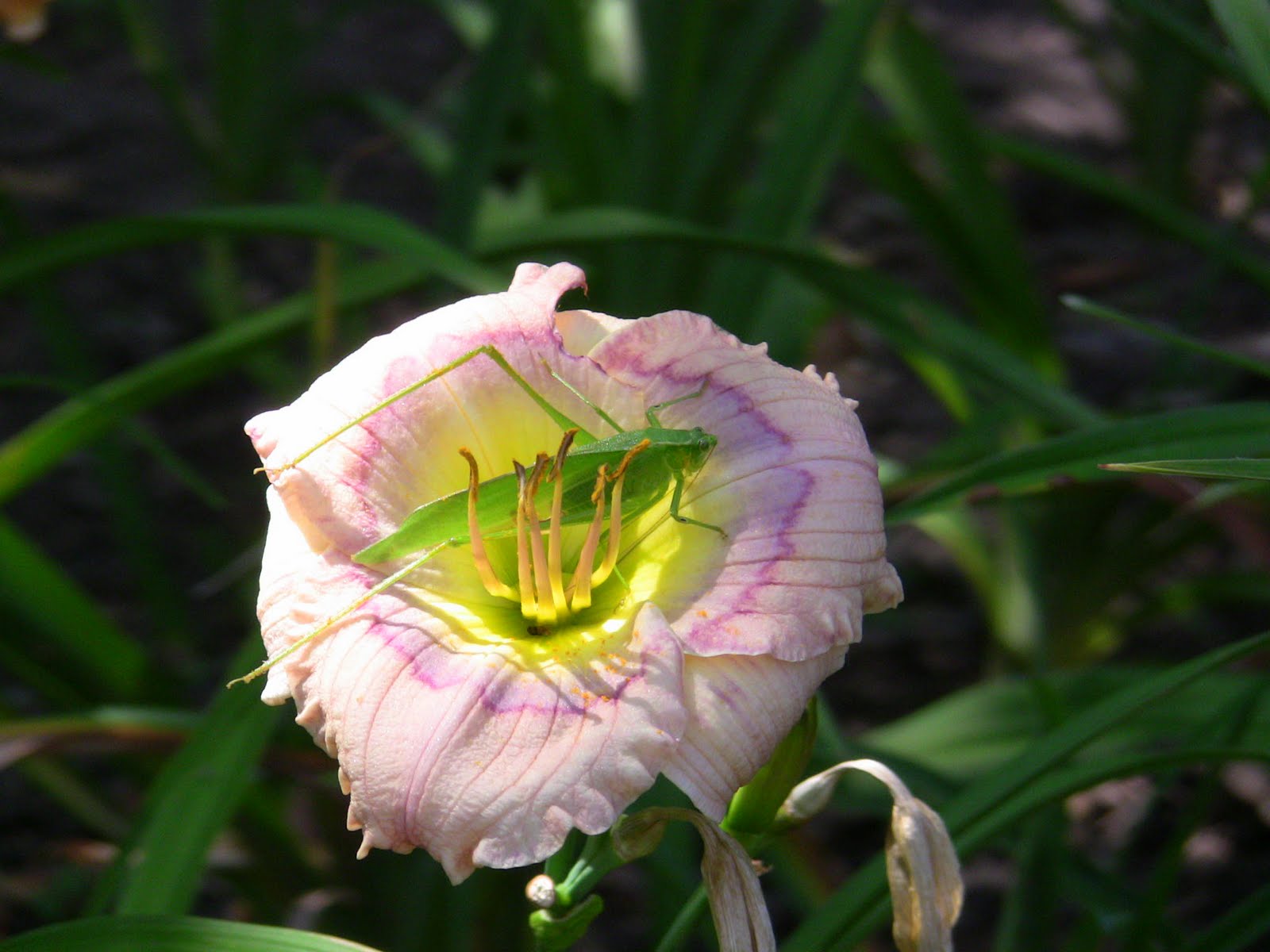
Wednesday, September 7, 2011

The Deadlines

My month-long blog hiatus can be explained in a single word: deadlines. What my gamer friends might call RL (real life) displaced my ability and energy to blog. But I'm back! I've got flower pictures, cat stories, and various musings about the orchid life. One of my deadlines involved an essay about Katy Perry. The essay recently appeared in an online venue (sponsored by the Sarah Lawrence College Women's History Graduate Program). It has nothing to do with orchids and cats (unless you count Hello Kitty! and Katycats) but you can read it here if you're interested. 
Today's flower is from an unregistered cross: Paph. primulinum x Paph. S. Gratrix. Specifically, it's Paph (primulinum 'Gold Bug' x S. Gratrix 'Algonquin' AM/AOS) from Windy Hill. I love it! The green is nice and clear, and the subtle red dotting from the S. Gratrix parent gives it its beautiful freckled-look. The stippling on the dorsal sepal is definitely not symmetrical but the way the red dots break away on the lateral petals is super cool. As an added bonus, it's blooming sequentially (the second flower bud is becoming more visible).

So, that's the good stuff going on in the Cats and Catts house. On a sad note, the orchid community lost one of its great contributors with the recent death of Fred Bergman. He taught me a lot about orchids and I know that I'm one of the many people who will miss his presence at our monthly meetings. It will be easy to remember Fred, though, if only because he has so many hybrids named after him. I'm a proud owner of Phal. Fred's Pimento, and his memory will live on through every bloom season.

Sunday, August 7, 2011

Where No Kitty Has Gone Before

Riley explores his Bajoran faith.
Trixie leaves for the Star Trek National Convention in just a few days. This is a HUGE yearly event in the Cats and Catts house involving months of planning and preparation. It's kind of a big deal.

Last year, Trixie wore two Deanna Troi costumes. This year, she's rocking another Troi outfit (it looks awesome!), a Trill costume (with airbrushed Trill spots), and a Dabo Girl costume. Dabo girls are Bajoran, so Trixie and her sister have hired a former Star Trek make-up artist to come to their hotel room in the morning to affix the proper Bajoran nose. Hardcore. I know. I live with it (as well as the voice-activated Tribbles in our living room). 

But I get it now. I watched the different series with her over the last few years and I think I finally understand the unique depth and devotion of Star Trek fans. Why is the Star Trek universe so awesome? I could reference its inter-textuality, how the plots, themes, and characters of Next Generation, Voyager, and DS9 form a canonical narrative, a grand story historically rooted in the original series and Enterprise. Or, I could make a "works on multiple levels" argument and list the layers of appeal (science, adventure, war, romance, etc.).

But the best argument for Star Trek are the Bajoran. I'm not saying that to be controversial. I'm not saying that because Kira Nerys (played by Nana Visitor) is my all-time favorite Star Trek character (although that's obviously part of the calculus). It's just ... I believe in Bajor. When I'm feeling down about the Earth world I can cheer myself up by envisioning a gorgeous planet with five moons, lush landscape, and occupied by humanoids with cute nose wrinkles and fun earrings. Bajoran culture, religion, and lifestyle are something to which we can aspire. And as for the "Kirk vs. Picard" debate, I would ask "So, refresh my memory: which of those Captains was the Emissary of the Prophets?" ('nuff said).  

Saturday, July 30, 2011

Total Dessication

Making your own daylily hybrids is all fun and games, but what if the two daylilies you want to cross aren't in bloom at the same time? The daylily breeder needs a method of preserving pollen for future use. The Internet has no shortage of opinions, but my four key go-to sources here are: Daylilies: The Perfect Perennial by Lewis and Nancy Hill, Oscie B. Whatley Jr.'s essay The Art of Hybridizing, John Peat and Ted Petit's The New Encyclopedia of Daylilies, and (even though it's not lily-specific) Moulton's Orchids from Seeds for Pennies. 

You'll find some variation in the advice but the experts are consistent about one point: the pollen needs to be dry. Moisture is the enemy of pollen.

A lot of the advice suggests storing pollen in the refrigerator because of its dryness. Some argue that freezing the pollen is better because you can extend its use to the next growing season. The trade-off, however, is that freezers lack proper air conditioning. 

Are you still awake?

First, we need to acknowledge that rain can always ruin our morning pollen collection and application efforts. The breeder should collect pollen early in the morning before humidity corrupts it. My pollen collection skills improved over the course of the summer and I tried a variety of techniques and tools. The easiest method, in my opinion, involves plucking the pollen with a pair of small scissors and shoveling it into a folded Post-It note. 

The pollen goes into a dessication chamber for 12-24 hours. For this purpose I'm using a canning jar with a piece of mesh cloth to create a platform inside the glass. I stir Damp Rid into a 1/4 cup of water until it gets thick, creating a "super saturated solution."

The final step requires a some kind of case, empty pill bottles, weekly pill cases, Damp-Rid, and a drill with a small bit. I store the pill cases in a plastic box. I use a small pill container (with holes drilled in the top and on the sides) with Damp Rid. Some of the weekly pill cases have holes drilled into the inside chambers with the final chamber containing a little bit of Damp Rid. Other pill cases have holes drilled into the top. 

We'll see how it works out next season! 

Thursday, July 28, 2011

Sharks, Seed Pods, and Patience

'Colony' (Tankesley-Clarke, 2004)
This is 'Colony,' a 2004 introduction by Eric and Bob Tankesley-Clarke. Let's dispense with the obvious criticisms: the form is a little mangled and it lacks desired bilateral symmetry. It might be due to grower error, its relative newness in the garden, and/or the streak of insane July heat we've experienced in Kansas. I know it might look washed out but (trust me) the color combo is dazzling: lavender, cream, and metallic. The cultivar is a cross between 'Wedding Band' (the "pod parent") and 'Desert Empress' (the "pollen parent"). You can see the influence of 'Wedding Band' in the gold edgings. Like 'Wedding Band,' photographs fail to convey its beauty, but a close-up is the next best thing. 
'Colony,' ready for its close-up

In the first photo, you see a green seed pod ripening on the scape. It's 'Spacecoast Scrambled' x 'Cosmic Sensation.' 'Cosmic Sensation' was probably my favorite this year owing to the vivid purple/white color contrast and the shark-toothed edging. Keeping with the theme, I recently purchased Elizabeth Shooter's 2001 introduction 'Playing With Sharks.' I bought it from Blue Ridge Daylilies, the only daylily vendor on Cats and Catts "Kitty Approved!" list. I'm on the lookout for 'Barracuda Bay' (Salter 1996) and 'Iwanna Piranha' (Kinnebrew 2006). In the meantime, my ('Spacecoast Scrambled' x 'Cosmic Sensation') could be the next Stout Silver Medal winner, or birds and bugs could be devouring the pod as you are reading this. Smart money will bet on the latter.

My latest MUST HAVE -- 'Playing With Sharks'

 The garden has only a few more blooms left before it closes down for the season. Daylily seed pods take about 40 days to mature from the day of pollination, so I need to stay with the daylily garden into early September to harvest the seeds. Plant-wise, I'll be enveloped into the orchid world from September to March. In March, daylily seedlings (started indoors) will go into the cold frame. Fireworks from the established daylilies will begin a few months later, but only after I've been thoroughly distracted by daffodils and tulips.


Gardening seems like it requires a great deal of patience, but I'm not so sure. I have orchids, daylilies, and other perennials at different stages of growth. I never need to be patient because there's always something in bloom, something in a death spiral, and everything in between. Every gardening day brings new challenges and joys, just like life. 

Monday, July 25, 2011

Vista Agave

Agave americana
Trixie and I were in Vista California for a relaxing vacation visiting friends and family. This gave me a chance to see all of the amazing landscaping efforts my parents have made in the last couple of years. Daylilies, Alstromeria, roses, orchids, and more. When my dad said that they had yellow daylilies, I assume they had 'Stella {{yawn}} de Oro,' but the lilies were much more impressive, with a bright color and 5-6" blooms.


An impressive Agave americana (century plant) sits in a neglected corner of the property. As a child, it always looked especially vicious and the bloom cycle seemed impossibly long (once every ten years!). The blooms go up about 30 feet and then fall down like a big tree. It dies after every bloom and then sends out pups. This plant has been loitering in that spot since at least the early 1970s. It's still impressive!

Friday, July 15, 2011

All That Glitters

This is 'Glitter Gal' (Mix 2005). I purchased it last year at the Topeka Daylily Sale. It's hard to believe that someone was willing to part with it, but it only produced three flowers for me this year and it might have done less for its last owner. It's a long way from the 6-way branching and 45 bud count promised in the catalogs. You have to have patience if you're going to court a glitter gal.

In other news, I'm on twitter. Follow me! But know I'm using it as an all-purpose account, so you'll find my political retweets and nutty Katy Perry updates right alongside the orchid and flower posts. 

Monday, July 11, 2011

Pollen Pushers

'Siloam David Kirchhoff'
I'm not the only one who collects pollen in the early morning. I compete with the insects, and they're probably having more luck than me. Some of my crosses have been a complete bust. I want to blame the weather, but I probably could've done a better job watering the garden. I took the resilience of the daylily for granted. The seed pods need hydrated soil to develp properly. 

'Fooled Me' x 'Pat Garrity' has produced nice pods and I'm almost confident I will have something to harvest in a few weeks. 'Janice Brown' x 'Beautiful Edgings' also shows promise. Other crosses might come through with a pod or two and, with a little luck, I'll have enough to fill the raised bed for next season. It's all a big experiment. Hybridizing daylilies might seem like it takes an extraordinary amount of patience, but it occurs with lightening fast speed compared to seed-to-flower time for orchids. And I kind of like the slow pace. 

Friday, July 1, 2011

I Love the Smell of Diethyl-meta-toluamide in the Morning

Early morning pollination
DEET doesn't smell like victory, but it allows me to leave the daylily garden without a ghastly array of chigger and mosquito bites. It's important for me to be outside during the summer months for at least two to three hours a day. The early morning is ideal. I collect daylily pollen, make crosses, water the orchids, take a few bird photos, and settle into work. Forgive me for talking about the weather, but the Midwest summer morning always seems like it's going to last longer than it does. For instance, it's a lovely 83 degrees right now and, although I know it's going to surpass 100 today, the perfection feels like it could last forever. Why wouldn't it?

'Beautiful Edgings' (Copenhaver 1989)
The extreme weather hurts the viability of my daylily crosses, but there's not much I can do. I made about twenty today and I will be happy if one or two set seed. Like so many things in gardening/life, hybridizing involves a balancing act. On one side, I'm playing a Darwinian numbers game. I want to make a large number of crosses in the hope that a smaller number of them survive. Then, I'll select from the best of the survivors the following season. On the other side, I don't want to make too many crosses because doing too much dilutes my efforts. My garden could produce nearly 100 hybrid combinations despite its small size, but when would I have time to water and care for the orchids? 
Here's my modest list of June crosses (the first name listed is the pod parent and the second name refers to the pollen parent):
'Early Snow' x 'Cosmic Sensation'
'Fooled Me' x 'Pat Garrity'
'Spacecoast Scrambled' x 'Royal Renaissance'
'Peach Candy' x 'Royal Renaissance'
'Cheddar Cheese' x 'Pat Garrity'
'Janice Brown' x 'Beautiful Edgings'
'Pat Garrity,' I hope, gives its offspring flatness and a giant red eye zone. I'm looking at 'Royal Renaissance,' 'Cosmic Sensation,' and 'Beautiful Edgings' to impart an awe-inspiring edge to their kids. The notion that my crosses will result in this greatness is wishful thinking (hence the Darwinian numbers game), but -- like the lottery -- you can't win if you don't play.
'Fooled Me' (Reilly-Hein 1990)
The month of June evaporated on me with unpredictable quickness, but July affords me more time to update you on the daylilies, the orchids and, of course, the kitties. Hello July!

Saturday, June 18, 2011

Cosmic Sensation

It's daylily time! I know it's that time of year because I have a slew of mosquito bites. Do you remember the scene in "The Right Stuff" (1983) where the astronauts undergo a battery of tests? And do you remember how one of the tests entailed Sam Shepard being stabbed in the flesh between his thumb and forefinger to test his pain tolerance? Mosquitoes bites on the hands are not on the list of world problems, but maybe they should be. 

Enough mosquito talk... Some of the new cultivars I purchased are starting to show their stuff. So far, 'Cosmic Sensation' (Salter 2002) is my favorite. The white shark-toothed edge jumps off of the lush purple background. It's been a generous bloomer and the flowers are perfectly spaced on the top of the scape. 

'Pat Garrity' (Stamile 2002) is another standout. The gold is bright and clear, but the strengths of this flower are its flatness and huge red eye. "Flat" is a relative concept when it comes to daylilies and -- compared to hybridizing programs for many orchids -- it's not coveted as an important breeding goal. The red eye is impressive because, despite the size of the eye zone, the break between the gold and the red is clean and unmuddied.


Finally, here's a cultivar I bought at the Topeka Daylily Club annual sale ('Oklahoma Kicking Bird' by Marley, 1987). The bloom is gigantic! I'm not immediately drawn to spider-form and unusual-form daylilies, but this one might win me over.

Tuesday, June 14, 2011

Two for One

I've been working way too hard for June, so I'm behind on everything. I expect to emerge from the work tunnel sometime soon. Until then, here's a photo I've wanted to post for a few weeks. 

This is a Brachypetalum hybrid from Orchid Inn. It's Paph. Sabatino x Paph. S. Gratrix. More specifically, it's Paph. (Muriel Constance x Greyi) var. album x S. Gratrix var. album 'Albino Beauty.' Obviously, the albino thing didn't work out with this cross, but I still find it pretty. The dots on the bottom half of the petals are more faded and maybe that's the album trying to assert itself.

What do you think about the fold at the tops of the dorsal sepals? From the point of view of the flower, the hooded dorsal protects the pouch from unnecessary rain that could ruin the flower or drown a potential pollinator. From the point of view of section 7.1.7 of the AOS Judging Manual, "The dorsal sepal should be large, rounded, slightly concave and not reflexed." It definitely fails in the "rounded" department, but does the dorsal hoodie count as "slightly concave?" From Lan Lan's point of view the flower is super cute, and I tend to agree.